by Joy Maitland | Aug 5, 2026 | Board Members, Board Trustees, CEO, CFO, COO, CIO, General Managers, Heads of Divisions, Human Resources (HR), Leadership Development, Managing Directors, Middle Managers, Non-Executive Board Members, Senior Managers, Women Leaders
The organisations most likely to succeed tomorrow may not be those with the best answers. They may be those willing to question today’s success.
Leadership curiosity has become one of the most important competitive advantages an organisation can develop.
In the early 1980s, Intel faced one of the most important decisions in its history.
Competition in the memory chip market had intensified, and the company’s future was becoming increasingly uncertain.
During a discussion with Intel co-founder Gordon Moore, then CEO Andy Grove asked a deceptively simple question.
“If we got fired and the Board brought in a new CEO, what do you think they would do?”
Moore paused before replying.
“They’d probably get us out of the memory business.”
Grove looked at him and said,
“Then why don’t we walk out the door, come back in and do it ourselves?”
That single question changed Intel’s future.
More importantly, it revealed something profound about leadership.
Sometimes the greatest threat to future success is not what we don’t know.
It is what we have stopped questioning.
Success Can Become a Blind Spot
Experience is one of leadership’s greatest strengths.
It helps us recognise patterns, make informed decisions and avoid repeating past mistakes.
However, experience also carries an often-overlooked risk.
Success reinforces confidence.
Confidence reinforces assumptions.
Over time, assumptions can quietly become certainty.
Processes that once created competitive advantage become untouchable.
Practices that once challenged conventional thinking become the convention itself.
Without noticing, organisations stop asking the questions that made them successful in the first place.
Microsoft Chose to Become a Learning Organisation
More than three decades later, Satya Nadella faced a different challenge at Microsoft.
The company remained hugely successful, yet many believed its culture had become inward-looking and overly certain of its own expertise.
Nadella’s response was remarkably simple.
Microsoft would become a company of “learn-it-alls” rather than “know-it-alls.”
It was far more than a slogan.
It represented a cultural commitment to curiosity over certainty.
Listening over defending.
Learning over proving.
People were encouraged to ask better questions, challenge assumptions and remain open to new ideas, regardless of seniority.
That shift helped transform not only Microsoft’s culture but also its ability to innovate in an industry changing at extraordinary speed.
Curiosity Is Becoming a Strategic Advantage
Artificial intelligence has made knowledge more accessible than at any point in history.
Information is no longer the scarce resource it once was.
Curiosity is.
The organisations that will thrive are unlikely to be those with the most information.
They will be those that continue asking difficult questions after everyone else believes the answers are obvious.
Curiosity has become a strategic capability.
Not because leaders lack confidence.
But because they recognise that confidence should never replace learning.
The Leadership Challenge
Every organisation develops habits.
Every leadership team develops beliefs.
Every successful strategy creates assumptions.
The important question is not whether those assumptions exist.
It is whether they are still true.
Leaders who remain curious create organisations that continue adapting.
Leaders who become certain often create organisations that slowly stop learning.
Insight: The organisations most at risk are rarely those that know too little. They are often those that believe they already know enough.
In an environment where technology, markets and customer expectations continue to evolve, curiosity has become far more than a personal characteristic.
It is a competitive advantage.
Because the future will not belong to organisations that defend yesterday’s answers.
It will belong to those that continue asking tomorrow’s questions.
Leadership curiosity is not simply about asking more questions. It is about creating a culture where long-held assumptions can be challenged before competitors challenge them for you.
Leadership Question
If an entirely new leadership team took over your organisation tomorrow, what long-held assumption would they challenge first.
The Right Conversation Can Change Everything. Let’s Talk.
by Joy Maitland | Jun 2, 2026 | Board Members, Board Trustees, CEO, CFO, COO, CIO, Emerging Leaders, General Managers, Heads of Divisions
Many organisations are investing heavily in knowledge transfer while quietly losing something even more valuable: judgement.
Most organisations have developed robust approaches to knowledge transfer.
They create onboarding programmes, learning platforms, process guides and increasingly sophisticated knowledge repositories.
However, many leaders are beginning to ask a different question.
Who is teaching the next generation what never gets documented?
Not the policies.
Not the procedures.
Not the technical knowledge.
The judgement.
The judgement to recognise when a project is beginning to drift.
The judgement to know when to challenge a client and when to listen.
The judgement to spot risks before they become problems.
The judgement to navigate ambiguity when there is no obvious answer.
These capabilities often separate competent professionals from exceptional ones.
Yet training manuals rarely capture them.
How Most People Really Learned
Ask experienced leaders how they learned some of the most valuable lessons in their careers.
Few will point to a course.
Instead, most will describe a person.
A manager who took them to important meetings.
A colleague who explained what was really happening behind the scenes.
A mentor who challenged their thinking.
A leader they observed handling difficult situations.
Most of this learning happened informally.
People learned by watching, listening, asking questions, making mistakes and receiving feedback.
In many organisations, professional judgement developed through proximity to experience.
The process was rarely structured.
Nevertheless, it was often highly effective.
The Risk Many Organisations Have Not Fully Considered
The challenge has become more visible as working patterns have evolved.
Hybrid and remote working have delivered many benefits, including greater flexibility, improved work-life balance and access to broader talent pools.
However, they have also changed how professional judgement develops and transfers between generations.
Historically, people learned many of the most valuable lessons informally. They observed experienced colleagues, listened to conversations, sat in meetings they were not leading and gained insight into how decisions were made.
Leaders and colleagues often passed on these lessons without intending to.
Today, organisations have become increasingly intentional about where work happens. Many have been less intentional about how judgement is transferred.
This does not mean hybrid working is inherently problematic.
It does, however, create a risk that organisations need to actively manage.
The risk is not simply that people miss information.
Rather, future leaders may have fewer opportunities to observe how experienced professionals think, prioritise and navigate complexity.
As a result, organisations may preserve productivity while unintentionally weakening apprenticeship.
Why Knowledge Transfer Is Not Enough
Many organisations believe they have solved the knowledge challenge.
The information exists.
The processes are documented.
The systems are available.
However, information and judgement are not the same thing.
Information can be stored. By contrast, people must develop judgement over time.
When experienced employees leave, organisations rarely lose information alone.
They also lose context.
They lose relationships.
They lose instincts.
Most importantly, they lose ways of thinking that helped people make effective decisions when there was no playbook.
These capabilities are difficult to measure. Consequently, leaders often overlook them.
Yet they frequently determine the difference between competence and effectiveness.
The challenge is no longer knowledge transfer alone.
Increasingly, it is judgement transfer.
What the Strongest Organisations Do Differently
The strongest organisations recognise that transferring knowledge and transferring judgement are different challenges.
Consequently, they do not assume people will absorb these capabilities naturally.
Instead, they create deliberate opportunities for mentoring, coaching, shadowing and cross-generational learning.
Experienced professionals explain not only what they decided, but also why they decided it.
Emerging leaders observe decision-making in practice rather than simply reviewing the outcome afterwards.
Moreover, these organisations understand that some of the most valuable development happens through exposure rather than instruction.
Organisations rarely view this type of learning as the most efficient.
However, it is often where future leadership capability is built.
Insight: Organisations often focus on knowledge transfer. Their greater challenge is transferring judgement.
As technology continues to improve access to information, this distinction becomes increasingly important.
Knowledge can be documented.
Wisdom usually has to be demonstrated.
Effective knowledge transfer remains important. However, transferring judgement may ultimately determine the strength of future leadership capability.
The organisations most likely to thrive will not simply be those that capture what people know.
They will be those that deliberately develop the next generation’s ability to apply that knowledge effectively.
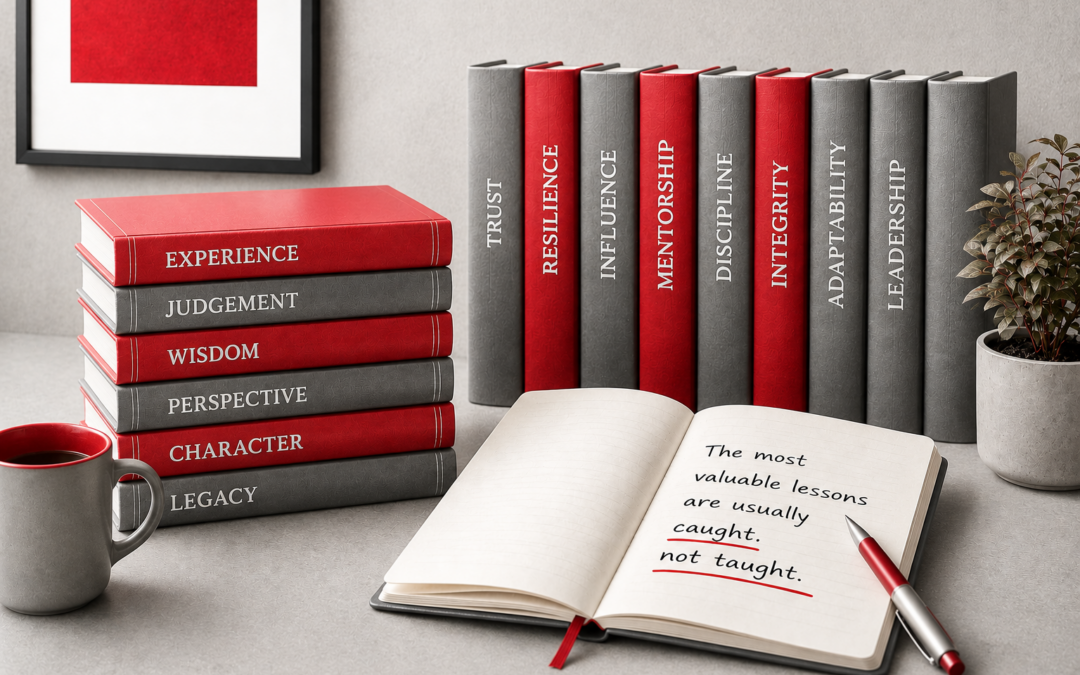
Because the most valuable lessons in an organisation are often the ones nobody thought to write down.
Leadership Question: If your most experienced people left tomorrow, what knowledge would remain and what judgement would leave with them?
The Right Conversation Can Change Everything. Let’s Talk.