by Joy Maitland | Aug 5, 2026 | Board Members, Board Trustees, CEO, CFO, COO, CIO, General Managers, Heads of Divisions, Human Resources (HR), Leadership Development, Managing Directors, Middle Managers, Non-Executive Board Members, Senior Managers, Women Leaders
The organisations most likely to succeed tomorrow may not be those with the best answers. They may be those willing to question today’s success.
Leadership curiosity has become one of the most important competitive advantages an organisation can develop.
In the early 1980s, Intel faced one of the most important decisions in its history.
Competition in the memory chip market had intensified, and the company’s future was becoming increasingly uncertain.
During a discussion with Intel co-founder Gordon Moore, then CEO Andy Grove asked a deceptively simple question.
“If we got fired and the Board brought in a new CEO, what do you think they would do?”
Moore paused before replying.
“They’d probably get us out of the memory business.”
Grove looked at him and said,
“Then why don’t we walk out the door, come back in and do it ourselves?”
That single question changed Intel’s future.
More importantly, it revealed something profound about leadership.
Sometimes the greatest threat to future success is not what we don’t know.
It is what we have stopped questioning.
Success Can Become a Blind Spot
Experience is one of leadership’s greatest strengths.
It helps us recognise patterns, make informed decisions and avoid repeating past mistakes.
However, experience also carries an often-overlooked risk.
Success reinforces confidence.
Confidence reinforces assumptions.
Over time, assumptions can quietly become certainty.
Processes that once created competitive advantage become untouchable.
Practices that once challenged conventional thinking become the convention itself.
Without noticing, organisations stop asking the questions that made them successful in the first place.
Microsoft Chose to Become a Learning Organisation
More than three decades later, Satya Nadella faced a different challenge at Microsoft.
The company remained hugely successful, yet many believed its culture had become inward-looking and overly certain of its own expertise.
Nadella’s response was remarkably simple.
Microsoft would become a company of “learn-it-alls” rather than “know-it-alls.”
It was far more than a slogan.
It represented a cultural commitment to curiosity over certainty.
Listening over defending.
Learning over proving.
People were encouraged to ask better questions, challenge assumptions and remain open to new ideas, regardless of seniority.
That shift helped transform not only Microsoft’s culture but also its ability to innovate in an industry changing at extraordinary speed.
Curiosity Is Becoming a Strategic Advantage
Artificial intelligence has made knowledge more accessible than at any point in history.
Information is no longer the scarce resource it once was.
Curiosity is.
The organisations that will thrive are unlikely to be those with the most information.
They will be those that continue asking difficult questions after everyone else believes the answers are obvious.
Curiosity has become a strategic capability.
Not because leaders lack confidence.
But because they recognise that confidence should never replace learning.
The Leadership Challenge
Every organisation develops habits.
Every leadership team develops beliefs.
Every successful strategy creates assumptions.
The important question is not whether those assumptions exist.
It is whether they are still true.
Leaders who remain curious create organisations that continue adapting.
Leaders who become certain often create organisations that slowly stop learning.
Insight: The organisations most at risk are rarely those that know too little. They are often those that believe they already know enough.
In an environment where technology, markets and customer expectations continue to evolve, curiosity has become far more than a personal characteristic.
It is a competitive advantage.
Because the future will not belong to organisations that defend yesterday’s answers.
It will belong to those that continue asking tomorrow’s questions.
Leadership curiosity is not simply about asking more questions. It is about creating a culture where long-held assumptions can be challenged before competitors challenge them for you.
Leadership Question
If an entirely new leadership team took over your organisation tomorrow, what long-held assumption would they challenge first.
The Right Conversation Can Change Everything. Let’s Talk.

by Atiya Sheikh | Aug 5, 2026 | Board Members, Board Trustees, CEO, CFO, COO, CIO, Emerging Leaders, General Managers, Heads of Divisions, Human Resources (HR), Junior Managers, Leadership Development, Managing Directors, Middle Managers, Non-Executive Board Members, Senior Managers, Women Leaders
As artificial intelligence becomes better at producing answers, the capabilities that distinguish exceptional people are changing.
For most of history, intelligence was limited by access to information. Today, it is increasingly limited by the quality of the questions we ask.
For generations, expertise was often measured by what people knew.
The person with the most knowledge frequently became the expert in the room.
Artificial intelligence is quietly changing that.
Today, information is available almost instantly. AI can draft reports, summarise meetings, analyse data, generate presentations and answer increasingly complex questions within seconds. Tasks that once required specialist knowledge can now be completed by almost anyone with access to the right technology.
This is one of the most significant shifts in the modern workplace.
Not because knowledge no longer matters.
But because knowledge alone is no longer enough.
AI Is Making Answers Cheaper
Throughout history, access to information created advantage.
Today, information has become abundant.
Increasingly, the competitive advantage lies elsewhere.
As AI makes producing acceptable answers faster, cheaper and more accessible, the value of simply having information inevitably declines.
What becomes more valuable is something AI cannot easily replicate.
- Judgement.
- Discernment.
- Curiosity.
- The ability to ask the question nobody else thought to ask.
- The confidence to challenge an answer that appears convincing.
- The wisdom to recognise when context changes everything.
Research reflects this shift. The World Economic Forum continues to rank analytical thinking among the most important skills for the future, alongside resilience, curiosity and lifelong learning. At the same time, organisations are investing heavily in AI while recognising that technology alone does not create competitive advantage. It is how people apply it that matters.
The New Definition of Expertise
Perhaps the most important change is not what AI can do.
It is what people now need to do differently.
For decades, expertise often meant providing answers.
Increasingly, expertise means framing the problem.
The quality of an AI-generated response depends almost entirely on the quality of the thinking that guides it.
A poorly framed question often produces a perfectly convincing—but fundamentally unhelpful—answer.
The opposite is also true.
A thoughtful question can unlock insights that would otherwise remain hidden.
In many organisations, this changes the nature of leadership.
The best leaders will not necessarily be those who know the most.
They will be those who help others ask better questions, challenge assumptions and think more deeply before acting.
The Hidden Risk
There is another consequence that receives far less attention.
Many professionals developed their judgement by completing the routine tasks that AI increasingly performs.
- Drafting papers.
- Analysing spreadsheets.
- Preparing presentations.
- Reviewing contracts.
Those activities were never simply about producing work.
They were how people learned to think.
If organisations automate those experiences without deliberately creating new opportunities for learning, they risk accelerating efficiency while quietly slowing the development of judgement.
The question is no longer whether AI will replace certain tasks.
The question is how future generations will develop the wisdom those tasks once created.
The Leadership Challenge
Leaders therefore face a different challenge from the one many expected.
The goal is not simply to encourage people to use AI.
Nor is it to compete with it.
The goal is to develop capabilities that become more valuable because AI exists.
- Critical thinking.
- Judgement.
- Creativity.
- Influence.
- Ethical decision-making.
- Systems thinking.
- The ability to connect ideas that appear unrelated.
These have always mattered.
Today, they matter even more.
Because as answers become increasingly accessible, the ability to recognise the right question becomes a defining competitive advantage.
Insight: Artificial intelligence is reducing the value of producing acceptable answers. It is increasing the value of recognising which questions deserve to be asked.
The organisations that succeed over the next decade will not simply adopt AI more quickly.
They will develop people who know when to trust it, when to challenge it and, perhaps most importantly, when to ask an entirely different question.
Because the future will not belong to those who can produce the fastest answer.
It will belong to those who can ask the question no machine thought to ask.
Leadership Question
As AI becomes better at providing answers, are you developing people who know how to ask better questions?
The Right Conversation Can Change Everything. Let’s Talk.
Microsoft Work Trend Index

by Joy Maitland | Aug 5, 2026 | Board Members, Board Trustees, CEO, CFO, COO, CIO, General Managers, Heads of Divisions, Human Resources (HR), Leadership Development, Managing Directors, Middle Managers, News & Articles, Non-Executive Board Members, Senior Managers, Women Leaders
Artificial intelligence isn’t making universities less relevant. It is forcing us to rediscover what higher education was always supposed to achieve.
Several years ago, inemmo was commissioned by a UK university to investigate a growing concern.
An increasing number of students were leaving during, or shortly after, their first year.
The university wanted to understand why.
What began as a study into student retention became something much more significant.
As we listened to students describe their experiences, it became clear that they weren’t simply questioning university.
They were questioning value.
Then one student said something that has stayed with me ever since.
“I’m only staying because I need the piece of paper.”
At the time, it sounded unsettling.
Today, it sounds remarkably prophetic.
They Weren’t Rejecting Education
As the interviews progressed, a clear picture began to emerge.
Long before ChatGPT entered everyday conversation, students were already asking questions that feel strikingly relevant today.
“Why am I paying to sit in lectures when I can learn much of this online?”
Some described watching YouTube tutorials that explained concepts more clearly than the lectures they had attended earlier that day.
Others spoke about reading research papers directly or completing specialist online courses.
Several questioned whether they would be better off gaining practical experience while avoiding years of student debt.
It would have been easy to conclude that students no longer valued learning.
The opposite was true.
They valued learning enormously.
What they questioned was where learning created its greatest value.
Perhaps the most surprising finding was not what they wanted to learn.
It was who they wanted to learn from.
Students repeatedly asked for greater exposure to people who had actually done the work.
People who had built businesses.
Led organisations.
Designed products.
Negotiated difficult decisions.
Made mistakes.
Recovered.
Started again.
They respected academic expertise.
However, what they were really asking for wasn’t more information.
It was interpretation.
Not another theory.
But what happened when that theory collided with reality.
Not simply what worked.
But why it worked.
When it failed.
What nobody anticipated.
And what they would do differently today.
One student captured it perfectly.
“Teach me what happened when the theory met reality.”
Perhaps, without realising it, they were asking for something that cannot simply be downloaded.
Judgement.
The Faculty Saw It Too
Interestingly, many faculty members recognised similar challenges.
Several spoke openly about becoming frustrated with traditional lecture-based teaching.
They wanted to spend less time delivering information and more time helping students think critically, solve problems, challenge assumptions and prepare for professional life.
Looking back, perhaps both students and academics had recognised something the rest of us had not.
The real value of higher education was never simply information.
It was transformation.
Information changes what people know.
Education changes how people think.
Those are not the same thing.
Then AI Changed the Conversation
When artificial intelligence entered everyday life, many predicted it would transform education.
Perhaps it has done something even more significant.
It has exposed a question we should have been asking all along.
If universities are no longer competing on access to information…
…where does their greatest value now lie?
Knowledge has become increasingly accessible.
The scarce resource is something altogether different.
Judgement.
Discernment.
Curiosity.
Perspective.
The ability to recognise nuance.
The wisdom to know when artificial intelligence is wrong.
The confidence to make decisions when there is no obvious answer.
These qualities cannot simply be downloaded.
They have to be developed.
Perhaps We’ve Been Measuring Different Things
To be fair, many employers recognised this long before artificial intelligence arrived.
Academic qualifications may open the door, but they have rarely secured the job on their own.
For many years, organisations have increasingly relied on competency-based interviews, assessment centres, case studies and psychometric assessments to understand how candidates think, solve problems and work with others.
Employers have long understood that knowledge alone is not enough.
Capability matters.
What artificial intelligence changes is not the importance of capability.
It changes the relative value of knowledge.
As information becomes easier to access, the ability to interpret it, question it and apply it wisely becomes even more valuable.
Perhaps that is where higher education and employment are beginning to converge.
Universities have traditionally excelled at developing knowledge.
Employers increasingly seek judgement, adaptability, collaboration and the ability to apply that knowledge in unfamiliar situations.
The challenge for the future may not be choosing one over the other.
It may be integrating both more effectively.
The University of the Future
Universities have survived wars.
Economic crises.
Political upheaval.
Industrial revolutions.
They will adapt to artificial intelligence too.
If anything, they may become more important than ever.
But perhaps their purpose will become clearer.
The institutions that thrive may not be those with the biggest libraries or the longest reading lists.
They may be those that become the world’s greatest developers of judgement.
Places where academic rigour is strengthened by practical experience.
Where researchers work alongside entrepreneurs.
Engineers alongside psychologists.
Clinicians alongside business leaders.
Military officers alongside behavioural scientists.
Not because theory has become less valuable.
But because theory gains meaning when it meets reality.
Perhaps universities have never simply been in the knowledge business.
Knowledge has always been the starting point.
Transformation has always been the destination.
Helping people think more clearly.
Question more deeply.
Judge more wisely.
Act more responsibly.
Artificial intelligence has not diminished the importance of higher education.
If anything, it has reminded us why it matters.
Because information can now be found almost anywhere.
Judgement cannot.
Insight: Artificial intelligence has not diminished the importance of education. It has reminded us what education has always been about. In a world where information is abundant, the institutions that create the greatest value will be those that develop judgement, curiosity, adaptability and the confidence to navigate problems that have no textbook answer.
Leadership Question
If information has become abundant, what is the one capability every graduate should possess before entering the workplace?
The Right Conversation Can Change Everything. Let’s Talk.
The future of jobs: World Economic Forum

by Atiya Sheikh | Aug 5, 2026 | Board Members, Board Trustees, CEO, CFO, COO, CIO, General Managers, Heads of Divisions, Human Resources (HR), Leadership Development, Managing Directors, Middle Managers, News & Articles, Senior Managers, Women Leaders
What one business leader’s refusal to make an easy profit teaches us about culture, trust and long-term success.
Imagine increasing the price of every product in your business by just 3%.
Most customers probably wouldn’t notice.
Your profits would rise almost overnight.
When the idea was suggested to Costco founder Jim Sinegal, he refused. He famously described it as “the business equivalent of taking heroin.”
At first glance, it seems an extraordinary comparison. However, what followed revealed a much bigger leadership principle.
After all, what harm could a modest price increase really do?
The answer had very little to do with pricing.
It had everything to do with culture.
The Decision Was Bigger Than the Numbers
On paper, the decision seemed straightforward.
A small increase in prices would have generated hundreds of millions of dollars in additional profit. Consequently, many businesses would have viewed it as sound commercial judgement.
Instead, Sinegal saw something very different.
He understood that Costco’s success had never been built solely on low prices. It had been built on something far more valuable: trust.
Customers believed Costco would always act in their long-term interest.
The moment that principle became negotiable, Costco itself would begin to change.
Not overnight.
Not dramatically.
But gradually.
That gradual drift is perhaps the greatest danger.
Organisations Rarely Drift Overnight
Most organisations do not lose their culture because of one catastrophic decision.
They lose it through a series of small compromises that slowly become normal.
“We’ll make an exception this time.”
“No one will notice.”
“It’s only temporary.”
“We’ll put it right next quarter.”
Individually, these decisions seem insignificant. Collectively, however, they redefine what the organisation is prepared to accept.
Over time, the exception becomes the expectation.
The compromise becomes the culture.
Leadership Is Often Tested in the Small Decisions
Leaders rarely wake up intending to weaken their culture.
More often, they face pressure.
Commercial pressure.
Operational pressure.
Time pressure.
As a result, the temptation is understandable.
A small shortcut.
A slightly lower standard.
A decision that delivers today’s result while quietly borrowing against tomorrow’s reputation.
The difficulty is that culture does not change through mission statements.
It changes through repeated decisions.
People pay far less attention to what leaders say than to what leaders consistently tolerate.
The Hidden Cost of Leadership Compromises
Insight: One of the most remarkable aspects of the Costco story is that the decision was not driven by what the company could do. It was driven by what it believed it should do.
That distinction matters.
Many leadership decisions are not constrained by capability.
They are constrained by values.
The strongest leaders recognise that protecting trust sometimes requires turning down opportunities that appear attractive in the short term.
Because trust, once compromised, is rarely restored through a single decision.
It is rebuilt one decision at a time.
Insight: Organisations rarely lose their way through one major decision. They lose it through a series of small compromises that gradually become acceptable.
Costco’s decision reminds us that sustainable success is rarely built by extracting the maximum value from every opportunity.
Instead, organisations build sustainable success by protecting the principles that caused people to trust them in the first place.
Because culture is not defined by the decisions leaders celebrate.
It is defined by the compromises they refuse to make.
The most damaging leadership compromises are rarely dramatic. They become visible only after small decisions accumulate over time.
Leadership Question
What is your organisation normalising today that would once have been unacceptable?
The Right Conversation Can Change Everything. Let’s Talk.
Business equivalent of taking heroin’: Why Costco refuses to raise prices even if no one will notice
by Joy Maitland | Jun 2, 2026 | Board Members, Board Trustees, CEO, CFO, COO, CIO, Emerging Leaders, General Managers, Heads of Divisions
Many organisations are investing heavily in knowledge transfer while quietly losing something even more valuable: judgement.
Most organisations have developed robust approaches to knowledge transfer.
They create onboarding programmes, learning platforms, process guides and increasingly sophisticated knowledge repositories.
However, many leaders are beginning to ask a different question.
Who is teaching the next generation what never gets documented?
Not the policies.
Not the procedures.
Not the technical knowledge.
The judgement.
The judgement to recognise when a project is beginning to drift.
The judgement to know when to challenge a client and when to listen.
The judgement to spot risks before they become problems.
The judgement to navigate ambiguity when there is no obvious answer.
These capabilities often separate competent professionals from exceptional ones.
Yet training manuals rarely capture them.
How Most People Really Learned
Ask experienced leaders how they learned some of the most valuable lessons in their careers.
Few will point to a course.
Instead, most will describe a person.
A manager who took them to important meetings.
A colleague who explained what was really happening behind the scenes.
A mentor who challenged their thinking.
A leader they observed handling difficult situations.
Most of this learning happened informally.
People learned by watching, listening, asking questions, making mistakes and receiving feedback.
In many organisations, professional judgement developed through proximity to experience.
The process was rarely structured.
Nevertheless, it was often highly effective.
The Risk Many Organisations Have Not Fully Considered
The challenge has become more visible as working patterns have evolved.
Hybrid and remote working have delivered many benefits, including greater flexibility, improved work-life balance and access to broader talent pools.
However, they have also changed how professional judgement develops and transfers between generations.
Historically, people learned many of the most valuable lessons informally. They observed experienced colleagues, listened to conversations, sat in meetings they were not leading and gained insight into how decisions were made.
Leaders and colleagues often passed on these lessons without intending to.
Today, organisations have become increasingly intentional about where work happens. Many have been less intentional about how judgement is transferred.
This does not mean hybrid working is inherently problematic.
It does, however, create a risk that organisations need to actively manage.
The risk is not simply that people miss information.
Rather, future leaders may have fewer opportunities to observe how experienced professionals think, prioritise and navigate complexity.
As a result, organisations may preserve productivity while unintentionally weakening apprenticeship.
Why Knowledge Transfer Is Not Enough
Many organisations believe they have solved the knowledge challenge.
The information exists.
The processes are documented.
The systems are available.
However, information and judgement are not the same thing.
Information can be stored. By contrast, people must develop judgement over time.
When experienced employees leave, organisations rarely lose information alone.
They also lose context.
They lose relationships.
They lose instincts.
Most importantly, they lose ways of thinking that helped people make effective decisions when there was no playbook.
These capabilities are difficult to measure. Consequently, leaders often overlook them.
Yet they frequently determine the difference between competence and effectiveness.
The challenge is no longer knowledge transfer alone.
Increasingly, it is judgement transfer.
What the Strongest Organisations Do Differently
The strongest organisations recognise that transferring knowledge and transferring judgement are different challenges.
Consequently, they do not assume people will absorb these capabilities naturally.
Instead, they create deliberate opportunities for mentoring, coaching, shadowing and cross-generational learning.
Experienced professionals explain not only what they decided, but also why they decided it.
Emerging leaders observe decision-making in practice rather than simply reviewing the outcome afterwards.
Moreover, these organisations understand that some of the most valuable development happens through exposure rather than instruction.
Organisations rarely view this type of learning as the most efficient.
However, it is often where future leadership capability is built.
Insight: Organisations often focus on knowledge transfer. Their greater challenge is transferring judgement.
As technology continues to improve access to information, this distinction becomes increasingly important.
Knowledge can be documented.
Wisdom usually has to be demonstrated.
Effective knowledge transfer remains important. However, transferring judgement may ultimately determine the strength of future leadership capability.
The organisations most likely to thrive will not simply be those that capture what people know.
They will be those that deliberately develop the next generation’s ability to apply that knowledge effectively.
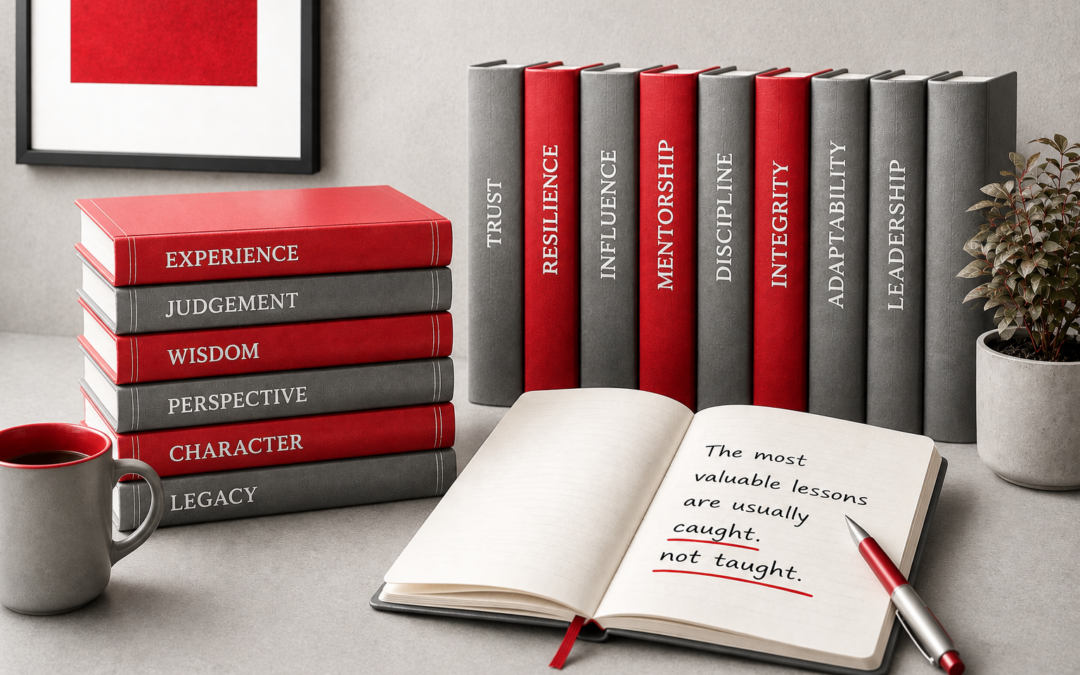
Because the most valuable lessons in an organisation are often the ones nobody thought to write down.
Leadership Question: If your most experienced people left tomorrow, what knowledge would remain and what judgement would leave with them?
The Right Conversation Can Change Everything. Let’s Talk.

by Joy Maitland | Jun 2, 2026 | Board Members, Board Trustees, CEO, CFO, COO, CIO, General Managers, Heads of Divisions
Most opportunities are won long before they appear.
Opportunity readiness is rarely discussed with the same discipline as risk management. Organisations spend significant time preparing for risk.
They develop contingency plans, manage uncertainty and work hard to anticipate potential threats.
Far fewer invest the same energy preparing for opportunity.
This is understandable.
Risks feel immediate. Opportunities feel hypothetical.
As a result, many organisations become highly effective at responding to problems while dedicating relatively little time to preparing for possibilities.
However, opportunities rarely arrive with enough time to prepare for them.
By the time a major client opportunity emerges, a strategic partnership becomes available or a new market opens, the organisations best positioned to benefit have often been preparing for months or years.
The capability already exists.
The relationships already exist.
The credibility already exists.
In many cases, the opportunity was won long before it appeared.
The Cost of Constant Delivery
One of the greatest challenges facing leaders is that operational demands consume attention.
Meetings fill calendars. Targets drive behaviour. Immediate priorities compete for focus.
Consequently, leadership energy becomes concentrated on delivery.
The future receives whatever time remains.
Over time, this creates a subtle risk.
Organisations become highly effective at executing today’s priorities while gradually reducing their readiness for tomorrow’s opportunities.
The issue is rarely a lack of ambition.
More often, it is a lack of space.
Capacity Creates Readiness
This challenge exists at both an organisational and individual level.
Many leaders spend the majority of their time solving operational problems, attending meetings and managing immediate priorities.
The work is important. It creates value. However, it can also create a subtle trap.
Over time, leaders become increasingly occupied with maintaining performance rather than preparing for what comes next.
In coaching conversations with senior executives, a recurring theme often emerges.
Many describe calendars filled with activity yet surprisingly little space for strategic thinking.
The assumption is often that visible contribution comes through involvement. If leaders are not actively solving problems, attending meetings or making decisions, they can begin to question whether they are adding sufficient value.
Yet some of the most valuable leadership work is invisible.
Building relationships before they are needed. Developing future capability. Exploring emerging trends. Preparing successors. Creating the capacity to respond when circumstances change.
These activities rarely deliver immediate results. However, they frequently determine who is ready when opportunity appears.
The same principle applies to organisations.
Those best positioned for future opportunities often recruit for potential, not simply current capability. They create room for learning, encourage broader thinking and develop leadership capacity long before growth requires it.
Building Opportunity Readiness
Many organisations assume they need more opportunities.
Often, they need more capacity.
Not operational capacity.
Strategic capacity.
The capacity to think, anticipate, prepare, adapt and act before circumstances demand it.
This is ultimately what opportunity readiness looks like in practice.
Insight: Organisations do not miss opportunities because they fail to recognise them. They miss them because they lack the capacity to pursue them.
The strongest organisations understand that readiness is not an event.
It is a discipline.
They create capacity before they need it. They invest in capability before demand requires it. They prepare leaders before opportunities emerge.
As a result, they are able to move when others are still trying to prepare.
Because opportunities rarely create readiness.
They reveal it.
Leadership Question: If a significant opportunity emerged tomorrow, what would your organisation wish it had started preparing for a year ago?
The Right Conversation Can Change Everything. Let’s Talk.