by Atiya Sheikh | Aug 5, 2026 | Board Members, Board Trustees, CEO, CFO, COO, CIO, Emerging Leaders, General Managers, Heads of Divisions, Human Resources (HR), Junior Managers, Leadership Development, Managing Directors, Middle Managers, Non-Executive Board Members, Senior Managers, Women Leaders
As artificial intelligence becomes better at producing answers, the capabilities that distinguish exceptional people are changing.
For most of history, intelligence was limited by access to information. Today, it is increasingly limited by the quality of the questions we ask.
For generations, expertise was often measured by what people knew.
The person with the most knowledge frequently became the expert in the room.
Artificial intelligence is quietly changing that.
Today, information is available almost instantly. AI can draft reports, summarise meetings, analyse data, generate presentations and answer increasingly complex questions within seconds. Tasks that once required specialist knowledge can now be completed by almost anyone with access to the right technology.
This is one of the most significant shifts in the modern workplace.
Not because knowledge no longer matters.
But because knowledge alone is no longer enough.
AI Is Making Answers Cheaper
Throughout history, access to information created advantage.
Today, information has become abundant.
Increasingly, the competitive advantage lies elsewhere.
As AI makes producing acceptable answers faster, cheaper and more accessible, the value of simply having information inevitably declines.
What becomes more valuable is something AI cannot easily replicate.
- Judgement.
- Discernment.
- Curiosity.
- The ability to ask the question nobody else thought to ask.
- The confidence to challenge an answer that appears convincing.
- The wisdom to recognise when context changes everything.
Research reflects this shift. The World Economic Forum continues to rank analytical thinking among the most important skills for the future, alongside resilience, curiosity and lifelong learning. At the same time, organisations are investing heavily in AI while recognising that technology alone does not create competitive advantage. It is how people apply it that matters.
The New Definition of Expertise
Perhaps the most important change is not what AI can do.
It is what people now need to do differently.
For decades, expertise often meant providing answers.
Increasingly, expertise means framing the problem.
The quality of an AI-generated response depends almost entirely on the quality of the thinking that guides it.
A poorly framed question often produces a perfectly convincing—but fundamentally unhelpful—answer.
The opposite is also true.
A thoughtful question can unlock insights that would otherwise remain hidden.
In many organisations, this changes the nature of leadership.
The best leaders will not necessarily be those who know the most.
They will be those who help others ask better questions, challenge assumptions and think more deeply before acting.
The Hidden Risk
There is another consequence that receives far less attention.
Many professionals developed their judgement by completing the routine tasks that AI increasingly performs.
- Drafting papers.
- Analysing spreadsheets.
- Preparing presentations.
- Reviewing contracts.
Those activities were never simply about producing work.
They were how people learned to think.
If organisations automate those experiences without deliberately creating new opportunities for learning, they risk accelerating efficiency while quietly slowing the development of judgement.
The question is no longer whether AI will replace certain tasks.
The question is how future generations will develop the wisdom those tasks once created.
The Leadership Challenge
Leaders therefore face a different challenge from the one many expected.
The goal is not simply to encourage people to use AI.
Nor is it to compete with it.
The goal is to develop capabilities that become more valuable because AI exists.
- Critical thinking.
- Judgement.
- Creativity.
- Influence.
- Ethical decision-making.
- Systems thinking.
- The ability to connect ideas that appear unrelated.
These have always mattered.
Today, they matter even more.
Because as answers become increasingly accessible, the ability to recognise the right question becomes a defining competitive advantage.
Insight: Artificial intelligence is reducing the value of producing acceptable answers. It is increasing the value of recognising which questions deserve to be asked.
The organisations that succeed over the next decade will not simply adopt AI more quickly.
They will develop people who know when to trust it, when to challenge it and, perhaps most importantly, when to ask an entirely different question.
Because the future will not belong to those who can produce the fastest answer.
It will belong to those who can ask the question no machine thought to ask.
Leadership Question
As AI becomes better at providing answers, are you developing people who know how to ask better questions?
The Right Conversation Can Change Everything. Let’s Talk.
Microsoft Work Trend Index
by Joy Maitland | Jun 2, 2026 | Board Members, Board Trustees, CEO, CFO, COO, CIO, Emerging Leaders, General Managers, Heads of Divisions
Many organisations are investing heavily in knowledge transfer while quietly losing something even more valuable: judgement.
Most organisations have developed robust approaches to knowledge transfer.
They create onboarding programmes, learning platforms, process guides and increasingly sophisticated knowledge repositories.
However, many leaders are beginning to ask a different question.
Who is teaching the next generation what never gets documented?
Not the policies.
Not the procedures.
Not the technical knowledge.
The judgement.
The judgement to recognise when a project is beginning to drift.
The judgement to know when to challenge a client and when to listen.
The judgement to spot risks before they become problems.
The judgement to navigate ambiguity when there is no obvious answer.
These capabilities often separate competent professionals from exceptional ones.
Yet training manuals rarely capture them.
How Most People Really Learned
Ask experienced leaders how they learned some of the most valuable lessons in their careers.
Few will point to a course.
Instead, most will describe a person.
A manager who took them to important meetings.
A colleague who explained what was really happening behind the scenes.
A mentor who challenged their thinking.
A leader they observed handling difficult situations.
Most of this learning happened informally.
People learned by watching, listening, asking questions, making mistakes and receiving feedback.
In many organisations, professional judgement developed through proximity to experience.
The process was rarely structured.
Nevertheless, it was often highly effective.
The Risk Many Organisations Have Not Fully Considered
The challenge has become more visible as working patterns have evolved.
Hybrid and remote working have delivered many benefits, including greater flexibility, improved work-life balance and access to broader talent pools.
However, they have also changed how professional judgement develops and transfers between generations.
Historically, people learned many of the most valuable lessons informally. They observed experienced colleagues, listened to conversations, sat in meetings they were not leading and gained insight into how decisions were made.
Leaders and colleagues often passed on these lessons without intending to.
Today, organisations have become increasingly intentional about where work happens. Many have been less intentional about how judgement is transferred.
This does not mean hybrid working is inherently problematic.
It does, however, create a risk that organisations need to actively manage.
The risk is not simply that people miss information.
Rather, future leaders may have fewer opportunities to observe how experienced professionals think, prioritise and navigate complexity.
As a result, organisations may preserve productivity while unintentionally weakening apprenticeship.
Why Knowledge Transfer Is Not Enough
Many organisations believe they have solved the knowledge challenge.
The information exists.
The processes are documented.
The systems are available.
However, information and judgement are not the same thing.
Information can be stored. By contrast, people must develop judgement over time.
When experienced employees leave, organisations rarely lose information alone.
They also lose context.
They lose relationships.
They lose instincts.
Most importantly, they lose ways of thinking that helped people make effective decisions when there was no playbook.
These capabilities are difficult to measure. Consequently, leaders often overlook them.
Yet they frequently determine the difference between competence and effectiveness.
The challenge is no longer knowledge transfer alone.
Increasingly, it is judgement transfer.
What the Strongest Organisations Do Differently
The strongest organisations recognise that transferring knowledge and transferring judgement are different challenges.
Consequently, they do not assume people will absorb these capabilities naturally.
Instead, they create deliberate opportunities for mentoring, coaching, shadowing and cross-generational learning.
Experienced professionals explain not only what they decided, but also why they decided it.
Emerging leaders observe decision-making in practice rather than simply reviewing the outcome afterwards.
Moreover, these organisations understand that some of the most valuable development happens through exposure rather than instruction.
Organisations rarely view this type of learning as the most efficient.
However, it is often where future leadership capability is built.
Insight: Organisations often focus on knowledge transfer. Their greater challenge is transferring judgement.
As technology continues to improve access to information, this distinction becomes increasingly important.
Knowledge can be documented.
Wisdom usually has to be demonstrated.
Effective knowledge transfer remains important. However, transferring judgement may ultimately determine the strength of future leadership capability.
The organisations most likely to thrive will not simply be those that capture what people know.
They will be those that deliberately develop the next generation’s ability to apply that knowledge effectively.
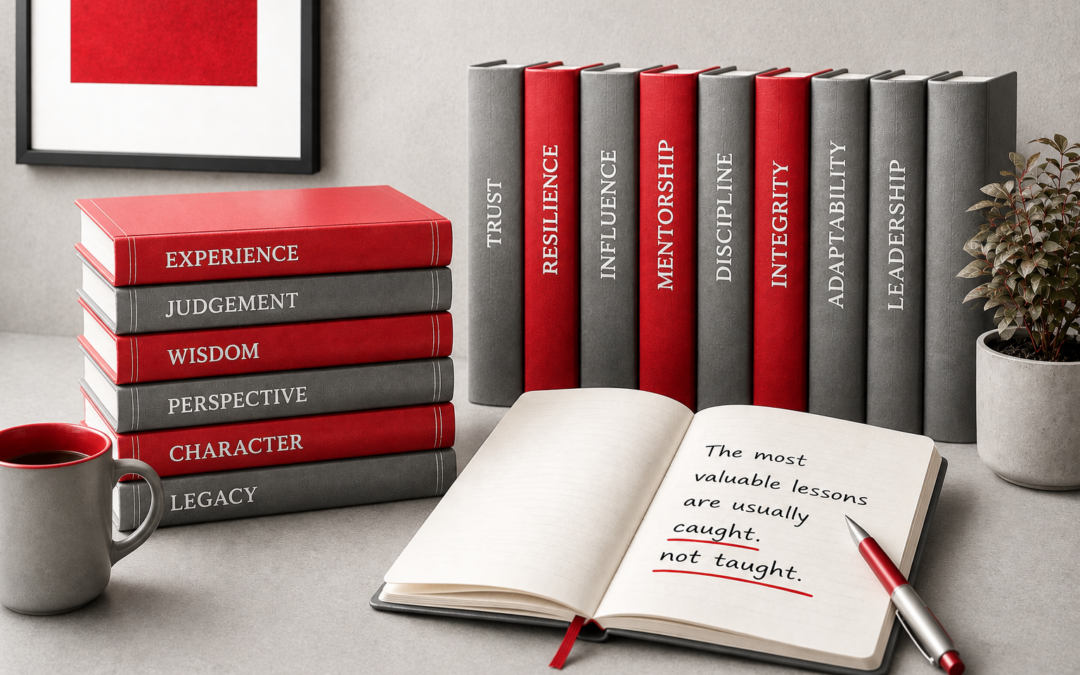
Because the most valuable lessons in an organisation are often the ones nobody thought to write down.
Leadership Question: If your most experienced people left tomorrow, what knowledge would remain and what judgement would leave with them?
The Right Conversation Can Change Everything. Let’s Talk.

by Atiya Sheikh | Mar 4, 2026 | Board Members, Board Trustees, CEO, CFO, COO, CIO, Emerging Leaders, General Managers, Heads of Divisions, Leadership Development, Managing Directors, News & Articles, Non-Executive Board Members
When activity becomes constant, organisations can lose the space required for strategic thinking.
Modern organisations rarely lack activity. Calendars fill quickly, meetings multiply, and leaders move constantly from one issue to the next. Yet when busyness becomes the norm, strategic thinking quietly begins to disappear.
Organisational busyness has become a defining feature of many leadership environments today.
Calendars are full. Meetings follow meetings. Messages flow across multiple channels throughout the day.
From the outside, this pace appears productive. Leaders look engaged and responsive. Teams appear active and committed.
However, activity does not automatically translate into progress.
Many leadership teams operate at such speed that they rarely step back to consider whether the organisation is moving in the right direction.
Insight: An organisation can be extremely busy and still make very little progress.
Busyness creates the feeling of momentum. It gives the impression that the organisation is moving forward simply because so much activity is taking place.
But something important is often lost in this environment: thinking.
Strategic thinking requires space. It requires moments where leaders are not responding to emails, attending meetings, or addressing immediate operational issues.
It requires the freedom to ask difficult questions.
- Are our assumptions still valid?
- What signals are emerging from the market?
- Which opportunities are we not seeing because we are too focused on current priorities?
Without these pauses, leadership teams become highly effective at managing the present but less capable of shaping the future.
Ironically, some of the most effective organisations operate at a calmer rhythm. Their leaders deliberately protect time for reflection. They schedule conversations that explore possibilities rather than simply review activity.
They understand that progress is not created by constant motion. It is created by motion guided by clear thinking.
Because when busyness becomes the culture, organisations can move quickly without moving forward at all.
Leadership Question: How much time does your leadership team spend thinking about the future rather than managing the present?
The Right Conversation Can Change Everything. Let’s Talk.

by Joy Maitland | Mar 4, 2026 | Board Members, Board Trustees, CEO, CFO, COO, CIO, Emerging Leaders, General Managers, Heads of Divisions, Human Resources (HR), Leadership Development, Managing Directors, Middle Managers, News & Articles, Non-Executive Board Members, Senior Managers, Women Leaders
Why execution falters not because of ambition, but because friction quietly accumulates inside the organisation.
Many organisations today do not struggle with strategy. Instead, they struggle with the quiet friction that slows progress once strategy moves from the page into the organisation. Understanding that friction is often the difference between ambition and real progress.
Across many organisations today, strategic ambitions are clear. Leaders articulate direction carefully, priorities are defined, and transformation programmes are launched with energy and intent.
Yet progress still stalls.
Targets slip. Initiatives slow down. Leaders feel that the organisation is working hard, but somehow not moving as far or as fast as expected.
The instinctive response is often to revisit the strategy. Perhaps it needs refinement. Perhaps the priorities need adjusting. Perhaps the vision needs to be communicated again.
But the problem is rarely the strategy itself.
Insight: Strategy rarely fails because it is unclear. It fails because the organisation’s structure quietly resists it.
The resistance is rarely dramatic. Instead, it appears in small forms of organisational friction that accumulate over time.
Departments pursue different priorities even though they share the same strategic objectives. Decision pathways require multiple approvals before action can begin. Incentives reward individual performance rather than collective progress.
None of these issues appears serious on its own. Yet together they create invisible resistance.
Energy is spent navigating the organisation rather than advancing the strategy.
This is why some organisations with elegant strategy documents struggle to generate momentum. Their operating systems were designed for stability, not speed.
Leadership therefore has a less visible responsibility: not simply to design strategy, but to remove friction from execution.
- Where do decisions stall?
- Where is ownership unclear?
- And why do teams often feel they are working hard yet pushing against resistance?
The leaders who generate real progress are rarely those who communicate strategy most eloquently. They are the ones who simplify the path between intention and action.
Strategy points the way.
Execution determines whether the organisation ever gets there.
Leadership Question: Where in your organisation does friction quietly slow progress between strategy and execution?
The Right Conversation Can Change Everything. Let’s Talk.

by Atiya Sheikh | Oct 24, 2025 | Board Members, Board Trustees, CEO, CFO, COO, CIO, Emerging Leaders, General Managers, Heads of Divisions, Junior Managers, Leadership Development, Managing Directors, News & Articles, Senior Managers
Incremental improvement is no longer enough. Let’s explore how leaders can reimagine value creation, embrace experimentation, and lead business model reinvention with clarity and courage.
The question every leadership team should be asking
If we had to start this business again today, would we build it the same way? For many leaders, the honest answer is no. Markets, technologies, and expectations have changed. Yet many organisations keep polishing yesterday’s model, hoping tomorrow will reward it. Incremental change feels safe. Exponential reinvention feels risky. But standing still is riskier still.
The illusion of progress
It is easy to look busy while falling behind. Upgrading systems, tweaking structures, launching add-ons — all signs of activity, not necessarily evolution. If your core way of creating value has not changed, you are not innovating; you are optimising the past. Reinvention begins when leaders ask,
“What business are we really in, and what business should we be in next?”
The signs it is time to rethink
Business model fatigue often shows up quietly:
- Margins erode despite rising sales.
- Decisions slow down.
- Teams protect the status quo instead of exploring what is possible.
When these patterns appear, it is time to reimagine, not just refine.
Reinvention is renewal, not disruption
Reinvention does not mean destroying what exists. It means rediscovering what gives your organisation life and extending it into the future. It could be shifting from ownership to access, from selling products to offering experiences, or from competition to collaboration. Whatever the form, it begins with curiosity.
The leadership challenge: creating space for possibility
Innovation rarely dies from lack of ideas; it dies from lack of permission.
Leaders set the tone. When every risk is punished, people play small.
When experimentation is valued, imagination returns.
Reinvention thrives where leaders replace certainty with curiosity.
A simple framework for renewal
- Identify where your model is under strain.
- Envision a future-fit approach to value creation.
- Pilot quickly, learn fast, adjust often.
- Build governance that rewards insight, not only outcomes.
This process turns reinvention into a disciplined practice rather than a desperate leap.
The human side of exponential growth
Behind every transformation is trust. People must believe that change builds on what they have achieved, not erases it. Leaders who honour the past while inviting the future create a sense of shared ownership. They communicate openly, involve teams in shaping the “how,” and celebrate learning, not just results. Because reinvention is powered by belief, not just capital.
A final reflection
Incremental change polishes what exists. Exponential change reimagines what is possible. Both have value, but only one prepares an organisation for the future. The leaders who will define the next decade are those who can balance stability with boldness.
Ask your leadership team,
“If we were starting again today, what would we do differently — and what stops us from doing it now?”
That single question could open the door to your organisation’s next chapter.
The Right Conversation Can Change Everything. Let’s Talk.

by Joy Maitland | Oct 24, 2025 | CEO, CFO, COO, CIO, Emerging Leaders, General Managers, Heads of Divisions, Human Resources (HR), Leadership Development, Managing Directors, Middle Managers
Work has changed, and so have people. Let’s explore how leaders can inspire commitment, prevent burnout, and create workplaces where purpose, performance, and well-being align.
The question leaders are asking quietly but urgently
Have we reached the point where working hard has stopped working?
Across organisations, teams are busy but drained. Engagement surveys speak of fatigue rather than fulfilment. Something deeper is shifting in how people experience work. The old equation — more effort equals more results — no longer adds up. We are being invited to rewrite it.
The end of the old contract
For years, the unwritten deal was clear: show up, perform, progress. Now people are asking different questions. Does this work still have meaning? Do I feel trusted? Is my contribution seen? Purpose, flexibility, and well-being have become expectations, not extras.
The reality of burnout: when purpose disappears
Burnout is not just about workload; it is about disconnection. It happens when effort feels endless but impact feels invisible. When people cannot see how their work connects to something meaningful, exhaustion follows. Leaders often treat burnout as an individual issue, but it is an organisational signal. The cure is not a mindfulness app. It is meaningful work.
The leadership reset: from control to connection
Modern leadership is less about managing activity and more about understanding energy.
The best leaders now ask,
- How do I help my team feel connected, not just informed?
- How do I balance empathy with accountability?
- How do I create space for rest without losing drive?
Connection builds trust, and trust sustains performance.
What people need from leaders now
- Clarity, so they can focus on what matters.
- Recognition, so their effort feels valued.
- Flexibility, so they can balance work and life.
- Purpose, so they can see meaning in what they do.
These are not soft ideas. They are strategic essentials for engagement and retention.
Building purpose-driven performance
Purpose and performance are partners, not opposites. Start meetings by reconnecting to purpose: “What impact are we creating this week?” End them by celebrating progress: “Where did we make a difference?” It is simple, and it changes the tone of work.
Leading through energy, not exhaustion
Energy management is now a leadership skill. Leaders who pace themselves create permission for others to do the same. Those who never rest send the message that exhaustion equals excellence. Sustainable performance depends on rhythm, not relentlessness. If your team’s calendar is full but their energy is low, it is time to pause, not push harder.
The new human equation
Work is no longer a transaction; it is a relationship. People give their best when they feel seen, valued, and purposeful. Leaders who understand this are redefining success. They create environments where ambition coexists with well-being, and where performance feels fulfilling, not draining.
Ask yourself,
“Are my people thriving because of our culture, or surviving in spite of it?”
Your answer will reveal how human your leadership really is.
The Right Conversation Can Change Everything. Let’s Talk.